Chapter 0 · Bonus chapterEyewitness Account
Found on the back pages of a school exercise book, three days north of the old city. Author unknown. Filed in the archive as a report without a number.
They will give me a number, when they find this. That is how they do it now. They take what is left of you and write a number over it, and then it lies in a box beside a hundred other numbers, and no one remembers that you once had a name, a voice, a particular way of drinking your coffee.
So I will write the names down first. Before the light goes entirely. Before my hand shakes too much.
Liss. Mattis. Little Senna, who was always late because she had to stop and pet every dog she met on the way. Emil with the glasses that were forever sliding down his nose. Tibb. Anik. The twins, whose names I still mixed up even after two years, which made them laugh every single time.
There were nineteen. I am writing them all down, every one, and if you are reading this, then read them aloud. Do me that kindness. It is the only thing I ask of you.
I was their teacher.
The morning began the way every morning begins, while the world still believes a morning is worth beginning.
It was bright. Too bright, I think now, but back then I only thought it would be a good day to leave the windows open. The sun fell in long, dusty ribbons through the high windows of the schoolhouse, and I remember the smell of it — warm wood, chalk, the apple someone had left on my desk because they believed that was the proper thing to do for a teacher. Outside, the traders were opening their stalls. A cart rattled over the cobblestones. Somewhere two women were arguing over the price of eggs, amiably, almost with relish, the way people argue when all they really want is to talk.
I was writing a sum on the blackboard. A simple one. Senna had her hand up before I had even finished, waving it as though she were trying to catch a fly, and I said, "Give the others a chance too, Senna," and she lowered her hand and rolled her eyes, and a few of the others giggled.
Emil pushed his glasses up, and they slid straight back down, and he chewed the end of his pencil the way he did when he was thinking, and I wondered whether I should tell him to stop, and decided to let it go, just for today. Tibb whispered something to Anik, and Anik smothered a grin, and I pretended not to notice. There were a thousand such small things that morning, and I paid attention to none of them, because I believed ten thousand more were coming, an endless procession of mornings in which a boy chews his pencil and two children whisper and a teacher generously looks the other way. That is how you think, when you take time for granted. You spend it the way a rich man spends money, certain that more will come tomorrow.
No more morning came. This one was the last, and I spent it without looking, on a sum that no one would ever finish.
That is the last entirely ordinary moment I remember. A girl rolling her eyes. A classroom giggling. The sun on the desks.
Keep that moment. I have kept it. It is all I have left.
It did not begin with a sound.
That is the first thing no one wants to believe, when I tell it — when I could still tell it, in those first days, before I stopped speaking. They expect thunder. A tremor. A trumpet from the heavens, like in the old stories. But the end came quietly. It came like a shadow loosening itself from a noon that had gone on too long, and that is exactly what it was, quite literally, only we did not yet have the word for it.
Mattis noticed it first. Mattis sat by the window, he always sat by the window, he was a dreamer, one of those I had admonished a thousand times to pay attention, and for the first and only time in his life it was a mercy that he was not paying attention, because that way he saw it before I did.
"Teacher," he said, and something in his voice made me let the chalk drop. "That man's shadow is not following him."
I went to the window. I remember every step. Three steps, four. Over the creaking board I had been meaning to fix for a year.
In the square below stood a man with a handcart. An entirely ordinary man, a greengrocer perhaps, in a brown jacket too big for him. He had come to a halt. And his shadow — his shadow no longer lay beneath him, the way a shadow is meant to lie. It stood. It had detached itself from the man's heels and was rising, slowly, testingly, like something stretching its limbs for the first time after a long sleep.
The man turned then. He raised a hand, almost curious, the way one reaches toward something strange one does not quite understand. And the shadow did not raise its hand.
Then it touched him.
There was no blood. That is the second thing no one wants to believe. No cry, no falling. The man simply stopped. One moment he was there, an irritable, living, breathing person who had been annoyed about the price of something he would never buy again, and the next there was only the cart, rolling slowly away because no one was holding it any longer, and the shadow, straightening and looking about, as though searching for the next.
Behind me it had gone silent. Nineteen children, and not a single sound. They had seen it too.
And then, from everywhere at once, the screaming began.
It rose from the streets like a flood you hear before you see it. Doors slammed. Something heavy fell and shattered. A woman screamed a name, the same name over and over, higher and higher, until her voice broke, and then she went on screaming it without a voice, I could tell by the shape of the sounds.
I should not have looked. But a human being is built to look, even when every fibre of him is screaming to turn away, and so I cast a single glance outside before I turned to the children, one breath long, and that one breath is enough to last a whole life.
The square, which a moment ago had been a market, had become something for which there is no word. People were running, but running did no good, for you cannot flee from what you yourself cast upon the ground. A man tripped over his own shadow, which had risen up before him, and was gone before he touched the earth; his hat rolled on, as though no one had ever worn it. The two women who that morning had been arguing so contentedly over the price of eggs were holding hands now, two old hands clasped together, and then the hands too were empty.
And in a doorway on the far side of the square, a young woman had pressed her child against the stone with her whole body, her face to the street. She did not scream. She did not pray. She had folded her arms back around the little one, one hand shielding its head, and she simply looked into the face of the thing crawling toward her across the cobbles, because she did not want to turn her child's back to it, I think — because the last thing her child should feel were her arms, and not the cold behind them. I saw her for a second, perhaps two. I do not know what became of her. I tell myself I do not know, and that is the truth, and it is also a cowardice, because I can imagine it well enough.
An old man knelt in the middle of the square, among overturned baskets from which apples were rolling, red apples over grey stone, and he had folded his hands and lifted his face to the sky and was praying aloud, in a firm, almost angry voice, to a god whose relics that morning answered for the first time in centuries — only not to him, and not in the way he begged.
Then I turned away. Some things you do not watch to the end, not because you are a coward, but because you still have something to do, and I had nineteen reasons to turn away, and every one of them sat trembling behind me.
I did what one does. I did what they train us for, without ever telling us that one day it would come to mean this. I turned to my class and made my face calm, as calm as I could, though my heart was beating against my ribs like a fist, and I said in a firm voice: "Away from the windows. All of you. Into the back corner. Now."
They obeyed. God bless them, they obeyed, nineteen children who rose and pushed back their chairs and ran to the furthest corner of the room, where the sun did not reach, away from the light I still believed, in that moment, to be the safe place. I did not know any better. How could I. No one knew anything that morning, except that you had to run, and that running did no good.
I placed myself in front of them. I spread my arms, as though two arms of flesh and a teacher in a worn jacket could hold back something that had no form. It was absurd. I would do it again. I would do it a thousand times again.
Senna had clawed her small hand into my jacket and pressed her face against my back. I felt her trembling. I felt them all trembling, a whole knot of trembling children pressing against one another and against me, and I laid one hand on Senna's head and said: "I am here. I am here. Look at me, not at the door. Look at me."
And they looked at me. That is the thing I cannot bear, when I close my eyes at night. That they looked at me. That they believed me.
The door did not hold for long.
It did not come splintering, not with force. It simply opened, slowly, as if by a draught, and in the gap there was no figure, no monster with teeth for the eye to fix upon. There was only darkness where there should have been light. A darker place in the bright doorway. It flowed over the threshold like spilled ink, without a sound, and where it slid across the ribbons of sunlight on the floor, the ribbons went out, as though it were drinking the light itself.
I did the only thing left to me. I pushed the children back with my whole body, against the wall, a breathing, weeping rampart of small bodies, and I lay down before them the way a man lies down before a storm, and I began to say their names. Aloud. One after another.
Liss. Mattis. Senna. Emil. Tibb. Anik.
I do not know why. I have thought about it a long time, in the many empty nights since, why a man in his last minute begins to say names. Perhaps because it was the only thing I could still give them. That someone knew their names. That they were not numbers, not to me, not in that room, not at the end of the world. That each of them had once been someone who came late because they petted dogs, or wore glasses that slid down their nose, or sat by the window and dreamed and so saw the end two breaths sooner than I did.
The twins. I said both names, and I did not mix them up, not this one time, and I wished they had laughed about it. They did not laugh. No one laughed anymore.
The darkness came across the floor toward us, and I saw — I swear, I saw it, even if no one believes me — that it hesitated. For a single moment. As though it were listening. As though names were something even it was not accustomed to.
Then it came anyway.
I will not write down what happened after. Not because I have forgotten. I forget nothing. It is only that some things do not belong in ink, because the ink would hold them forever, and they are not meant to be held forever. They are meant to vanish with me, when I vanish, and that is soon.
I will say only this: I did not fail because I was not strong enough. I failed because against what came that morning, no strength helped. No faith. No weapon. No love. Love does not stop the end. That is the lie we are told from our earliest days, and it is a beautiful lie, and I told it to my pupils too, and I do not regret it. But it is false. Love does not stop the end.
It only holds fast to what remains at the end. That is something else. That is less. Sometimes I think it is everything.
When it was over, I was still there.
That is the part I understand least and hate most. Why me. Why not Senna, who petted every dog. Why not Mattis, who still had his whole life ahead of him to dream out of windows. I have found no answer. Perhaps there is none. I have learned that the worst thing is not the dying. The worst thing is being the one left over.
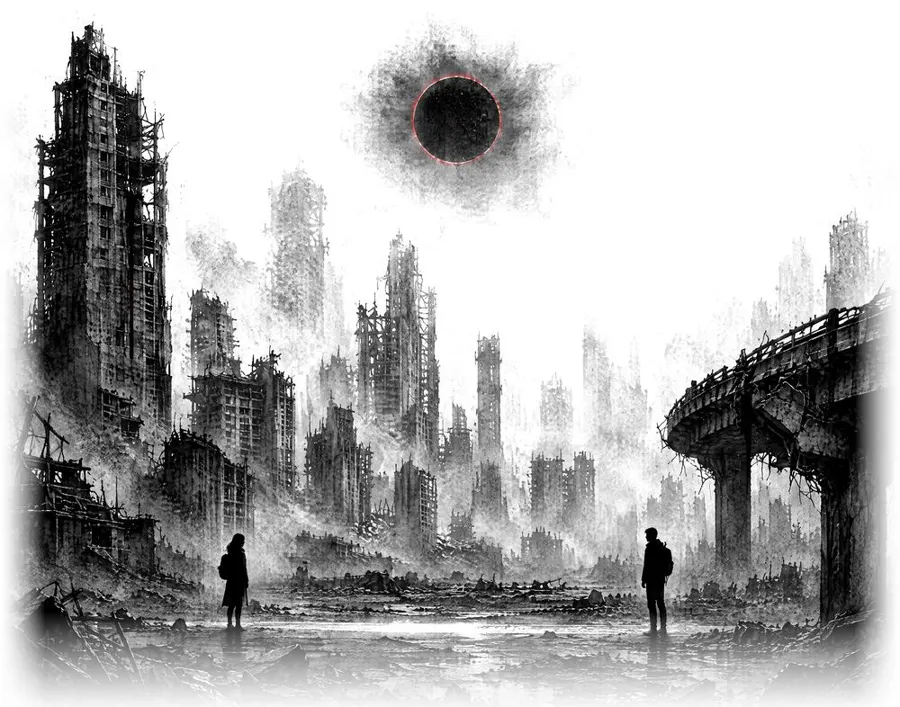
I walked through the town, afterward. I do not know how long I walked. The sun still stood high, it was still the same morning — can you believe that? It had taken less than an hour to end the whole world. One hour. We had believed the end of the world would need years, wars, signs. It needed one hour on a morning that was too bright.
Everywhere the shadows lay still, sated, sluggish, like dogs after feeding. And everywhere lay the things people had left behind without falling — a hat on the cobbles, a still-warm loaf on a stall, a pram rocking gently against a kerb, empty. No bodies. That is the most dreadful thing I can tell you. There were no bodies to weep over, none to bury. There was only what remains when someone is erased from the world: a ring in a puddle, a single shoe, a name that belongs to no one anymore.
I called out. That embarrassed me, later, and then it stopped embarrassing me, for there is a point beyond which nothing is embarrassing anymore. I walked through the empty alleys and called into the open doorways, some name, any name I knew, and waited for an answer that did not come. The silence was the worst of it. Not the kind of silence in which there is nothing, but the kind in which, a moment ago, there had been everything. A town full of chairs still warm. Full of pots still simmering their food, over fires no one would ever put out. Once, only once, I heard something: the creak of a cradle still moving, in a house with an open door, and I ran inside with a hope so fierce it hurt, and the cradle was only swaying in the draught of the open door, back and forth, back and forth, empty. I stood before it a long time. I gave it one last push, I do not know why, and watched it swing itself out, slower and slower, until it too was still, as everything was still.
In the great church on the square, a bell was ringing. On its own. No one was pulling the rope. It rang in a slow, even measure, and on the altar — through the open door I could see it — something glowed, an old reliquary, a thing before which people had knelt for hundreds of years and which in all that time had done nothing, nothing at all, only lain there and looked like gold. Now it glowed. Now, when there was no one left to pray, heaven finally answered. I have never understood it. I do not think it is to be understood. What we revered and what we feared awoke on the same morning, and neither of them came to save us.
They say that far to the east there is a place. A fortress. They gather the old things there, it is said, the glowing ones, the ringing ones, and there are people who have learned to wield them like weapons, and behind their walls one is said to be safe.
I do not believe it. I no longer believe in anything that promises walls and safety. But I write it down all the same, in case it is you who is looking for that place. Go. Chase a rumour as you would a light. It is the last thing to die, hope, and perhaps you are young enough that you can still afford it.
I am not. I will stay here, in the schoolhouse, in the back corner where the sun does not reach. I have set the chairs back in their places, neatly, in rows, the way I taught them. It is foolish. I know it is foolish. But it is what I can do.
When they find this, they will give me a number. That is all right. I understand why they do it — one cannot name every single loss, one would go mad, there are too many, and more every day. A number is kinder. A number can be filed away, and closed, and slept upon